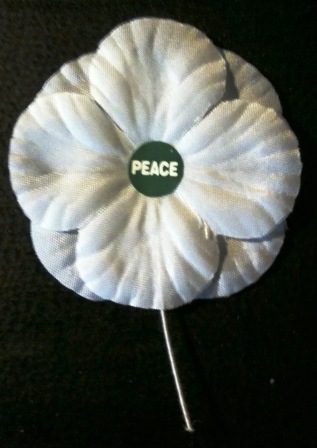
The idea of the white poppy isn't a new thing, as many seem to think, it dates back to 1926 when a group of people thought it made sense to separate Armistice Day and the red poppy from their military roots. Having the military involved in remembrance is like having arsonists speak up for those injured in fires.
Somewhere in the region of 10 million soldiers were killed during World War One plus an estimated one and a half million civilians across Europe. As the soldiers returned to their homes, they noticed how the cornfield poppy, a delicate flower, continued to grow across Northern France and into Belgium. These returning ex-servicemen decided to make the red poppy their emblem, symbolizing their loss and their suffering.
It was, of course, immortalized in John McRae's famous poem In Flanders Fields:
In Flanders fields the poppies blow
Between the crosses, row on row,
That mark our place; and in the sky
The larks, still bravely singing, fly
Scarce heard amid the guns below.
We are the Dead. Short days ago
We lived, felt dawn, saw sunset glow,
Loved and were loved, and now we lie
In Flanders fields.
Take up our quarrel with the foe:
To you from failing hands we throw
The torch; be yours to hold it high.
If ye break faith with us who die
We shall not sleep, though poppies grow
In Flanders fields.
The Americans organised artificial poppies to be made by women in northern France and the funds raised from sales would be used to help children who had suffered as a result of the war.
When British soldiers returned there was no heroes' homecoming as many had expected; many were wounded, disabled, suffering effects from gas and, of course, shell-shock. Thousands, as a result of mental and physical injuries, were unable to work and, in the days before social services, the state's provision was inadequate. The British Legion was formed in 1921 to support such ex-servicemen.
It was suggested that the British Legion might also like to sell artificial poppies and the first batch of one and a half million sold out almost immediately raising over £100,000. Due to its phenomenal success, the British Legion established its own factory, staffed by disabled ex-servicemen, to manufacture artificial poppies for future poppy appeals. It immediately became an annual event.
Today, the British Legion manufactures about 32 million artificial poppies annually alongside wreaths and crosses of remembrance. Poppies are seen everywhere: television presenters who are normally meant to show neutrality, sales in school classrooms with letters home to parents (I know of one who was asked why their daughter had not been given money for a poppy!), politicians wear them prominently as do shop assistants normally barred from non-uniform items being displayed, and even the police can wear one on their uniform when they wouldn't normally be allowed to have a charity badge. Members of the peace movement have commented on the Poppy Fascism that exists annually from late October into mid-November. The Red Poppy has become the symbol of the establishment and has lost any meaning in helping those hurt by war.
In recent years, increasing numbers have expressed their doubts about the importance and significance of the red poppy: expressing concerns about the poppy's connection to the military and how it is used to hype up images of heroism, jingoism and, ultimately, justify the use of military force (just watch a few minutes of the Service of Remembrance held at the Royal Albert Hall which is always broadcast on the BBC to see). Others have expressed concerns that the British Legion is unnecessary as their is enough state care and benefits for the wounded and disabled. Others are concerned at the profligacy of the British Legion - it's administration costs are high compared to other charities.
Is the red poppy really about care for the wounded or is it more to do with propaganda for the military?
The introduction of a second high-profile charity, Help for Heroes, is even more dubious in its purpose and throws into doubt whether the British Legion is doing any of the things it set out to do.
On the black central circle, red poppies used to have "Haig Fund" imprinted. The No War Movement asked that this be changed to "No More Wars" but, because the request was declined ("Haig Fund remained until the mid-1990s), the pacifist movement decided to manufacture and sell their own poppies.
In 1933, the Co-operative Women's Guild produced the first white poppies to be worn on Armistice Day. They stated that the white poppy was in no way intended as an insult to those who died in the Great War but a challenge to the continuing drive to war. In 1934, the Peace Pledge Union was formed and they, together with the Co-operative Women's Guild, have continued to organise the distribution of white poppies ever since.
The white poppy is a symbol of peace. It shows a distaste for the military and it remembers the people, increasingly civilians, who have their lives wrecked by wars which, increasingly, have limited legal and moral justification and can be avoided.
War is a crime against humanity.
More must be done to strive for peace. It is not about long haired hippies singing protest songs. War affects us all.
I will continue to shun the militaristic red poppy and wear a white poppy, no matter what the knuckle-draggers say.
Click here for information about how and where to get hold of a white poppy.

